We have all heard that smoking is bad for our health. But do any of us know why? Most of us probably think we do know why. Well, then why would people still smoke? Do we know with certainty that second-hand smoking exists? Do we need to worry about children that are exposed to smoke on a regular basis?
Hello, my name is Andrew Wegner. I am writing this blog to answer some of the common questions that smokers and non-smokers alike ask themselves and others all the time. I have seen the harmful effects of smoking first-hand. When I was younger, my parent’s friends were all smokers. Now as they are aging, they are beginning to struggle with the truly devastating effects of smoking that they either chose to neglect or were uneducated of. I am writing with the purpose to translate some of the scientific research that has been conducted concerning first-hand and second-hand smoking. Hopefully, you will find this blog helpful in providing information about the effects of smoking.
Does smoking actually hurt you?
To be upfront and clear, yes. Yes, it does.
A lot of people just don’t know how it hurts us.
For that information, we can look to resources like the Center for Disease Control (CDC) and the American Cancer Society (ACS). According to those resources, first-hand smoking puts an individual at risk of being diagnosed with at least 12 different types of cancer. Exposure to second-hand smoke puts an individual at risk for at least 9 types of cancer.
There are countless health risks that are caused by smoking, in addition to the large variety of cancers that an individual is already at risk for. Smoking puts an individual’s cardiovascular health, reproductive health, respiratory health, and physical health at risk. Individuals that are exposed to second-hand smoke have a slightly lower risk than first-hand smokers but a risk all the same.
There are two words that need to be defined before moving forward, mainstream smoke and sidestream smoke. Mainstream smoke is exhaled from the smoker. Sidestream smoke is the smoke that comes from the burnt end of the cigarette. According to the ACS, sidestream smoke is more dangerous because it has a high concentration of toxic chemicals. Both of these types of cigarette smoke are apart of what constitutes second-hand smoke.
The image below is shown in the Surgeon General’s report on “The Health Consequences of Smoking – 50 Years of Progress”. This diagram shows the wide variety of organs, glands, and tissues that are negatively impacted by smoking or exposure to smoke.
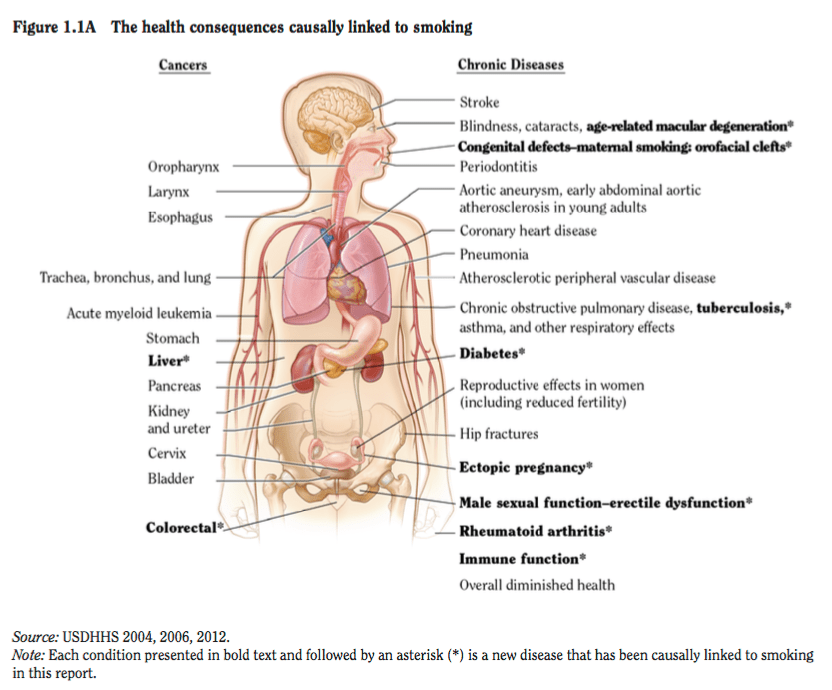
To help make sense of this image and the information provided in the Surgeon General’s reports from 2004 (“The Health Consequences of Smoking) and 2014 (“The Health Consequences of Smoking – 50 Years of Progress”), I will break down each major system that is impacted by exposure to smoke.
The evidence collected from the 2004 and 2014 reports by the Surgeon General point to a relationship between smoking or exposure to smoke and the following ailments:
Respiratory Health
- Chronic obstructive pulmonary disease (COPD)
- It was found that smoking was the dominant cause for COPD
- Tuberculosis
- Encompasses exacerbation, death risk, and risk from second-hand smoke exposure
- Exacerbation of asthma in adults
- Acute respiratory illness (pneumonia, etc.)
- Smoking during pregnancy led to a reduction in lung function/development in newborn infants
- Impaired lung growth during childhood
Most of these ailments may lead to death.
Cardiovascular Health
- Heart disease
- Stroke
- An increased risk of 20-30% for exposure to second-hand smoke
- Abdominal aortic aneurysm (large blood vessel rupture)
- Subclinical atherosclerosis
All of these ailments may lead to death.
Reproductive Health
- Smoking during pregnancy may lead to:
- Premature delivery
- Restricted growth and birth weight of an infant
- Sudden infant death syndrome
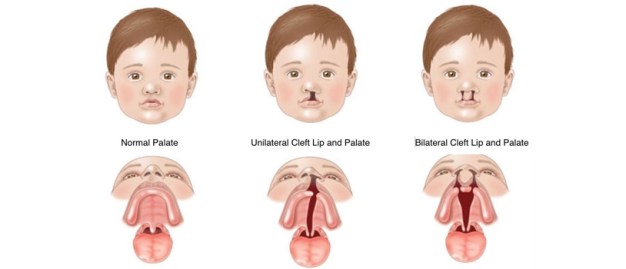
- Orofacial Clefts
- The underdevelopment of the skin and bone structure between the top of the lip and the bottom of the nose. The image below shows the difference between a fully developed lip and palate of a child and a cleft lip and palate.
- Ectopic pregnancy
- When a fertilized egg attaches outside of the uterus
- Erectile dysfunction
- Reduced fertility in women
Some of these ailments may lead to death.
Physical Health
- Macular degeneration
- A retinal disease where a portion of the retina deteriorates over time
- Diabetes
- An increased risk of 30-40% for active smokers
- The weakening of the immune system
- Rheumatoid Arthritis
- Lowered bone density in older men and women
- Periodontitis
- Infection for the gums and bone
Some of these ailments may lead to death.
In the Surgeon General’s report from 2004, we were informed of quite a few harmful effects that smoking has on the body. A few years ago, the Surgeon General released a report covering the same material in 2014. During that 10-year period, we saw a dramatic increase in the research conducted on the effects of smoking. There is a large amount of information that has been discovered over those short 10 years. It’s easy to see that there is no shortage of harmful effects of smoking that are being discovered.
Nowadays, we see less young people smoking because they are being educated about the unfortunate realities that come with the habit of smoking. The best we can do is to inform ourselves and those around us of what may stem from continuous exposure to first or second-hand smoke.
Secon-Hand Smoking Simile
I have come to understand the effects of smoking by associating smoking and it’s area of effect to a grenade. Smoking or being exposed to second-hand smoke is like experiencing a grenade explosion. The image below helps in explaining this association.
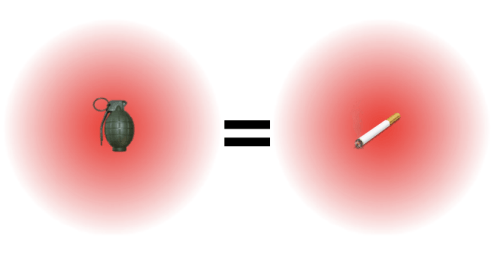
The red gradient around both the grenade and the cigarette show the area of damage. When a grenade explodes, the people that are closest to the grenade will be more injured than those people who are further. Likewise, the person holding the grenade will suffer the worst injuries.
The same can be said about smoking. The person smoking is suffering the greatest harm. The individuals around the smoker will suffer varying degrees of harm due to the ambient smoke in the air. The people closest to the smoker will be afflicted greater than those who are further away.
The message that I am trying to convey is this: every person in a smoke-filled environment is at risk. No single person is protected from the harmful effects of smoke.
How does smoking impact people’s lives?
The ACS states that all exposure to second-hand smoke, regardless of duration, is dangerous. Due to the aforementioned health risks, the dangerous properties are not only being inhaled by the smoker but exhaled as well. This puts all individuals that are near the smoker in danger. When I was younger, and before my parents knew of the risks of second-hand smoke I was exposed to it. Thankfully, I am not at a such a great risk because I was seldom in a smoke-filled environment. Unfortunately, there are young children in our country who are unable to escape these smoke-filled environments and may be exposed to it daily.
15 out of every 100 people smoke on a regular basis in the United States, according to the CDC. There are a lot of people who are not included in this statistic who are being exposed to secondhand smoke at the same time. The chemical known as nicotine is responsible for the addiction that smokers commonly face. Nicotine can be found in high concentrations in cigarettes.
According to a report by the Surgeon General in 2014, cigarettes are designed and manufactured in order to make them more addictive. The addictive properties result from the high concentrations of nicotine in cigarettes, as well as three additional chemicals that make the addiction well-fortified. This “chemical cocktail” makes it difficult for an individual to quit smoking. If a person were to attempt to go cold turkey, they would likely experience withdrawal.
Addiction dictates a person’s life. Unfortunately, even if a smoker wants to quit they are often unable to do so because the withdrawal symptoms are too damaging, the can’t mentally bring themselves to do it or for a different personal reason. I saw this internal struggle with my parent’s friends as they attempted to quit smoking when I was a teenager.
There are many resources to help an individual quit smoking, but we as caring individuals should understand the struggle they are facing before we label them as “being lazy” or “not caring about themselves or others” for not quitting cold turkey. Support and encouragement goes a long way.
With all that being said, if you are a smoker, you may want to take a look around before you light up because even if you’ve decided to accept the risks that come with smoking you should ask yourself, have the people around you accepted those same risks, too?”
For more information about the cost of smoking, please refer to my blog post: The Cost of Smoking. Can you Afford It?
For more information about the government and state policies being put in place, please refer to my blog post: Laws and Policies about Smoking
For more information about my personal opinion on the subject of smoking, please read and comment on my debate blog post: Should Smoking Tobacco be Illegal?
Resources:
American Cancer Society: Health Risks of Secondhand Smoking
American Cancer Society: Health Risks of Smoking
Center for Disease Control and Prevention: Health Effects of Cigarette Smoking

 Is Smoking Actually Bad?